Hidden SEO tactics that still rank in 2026

The “10 SEO tricks” listicles from 2019 don’t work anymore. Google’s Helpful Content Update demolished most of them. AI Overviews ate the rest. But a handful of tactics — none of them flashy — still move the needle hard in 2026. We use these across our portfolio every week.
This isn’t an “ultimate guide.” It’s the list of moves we actually run when a client signs and we have 90 days to show a graph going up and to the right.
1. Write the answer in the first 50 words
LLMs and AI Overviews extract content from the top of the page. Most posts bury the conclusion under 400 words of intro filler — they’re invisible to AI engines and feel slow to humans. Put the conclusion, the actionable answer, or the specific number in the first paragraph.
For this post: tactic #1 in the first 50 words is “write the answer first.” We did it on purpose.
2. Internal links with descriptive anchor text — and lots of them
Most sites have one internal link per post if any. The sites that compound have five to ten. Anchor text is the strongest signal of what a linked page is about, both for Google and for LLMs trying to map your site structure. “Click here” is wasted real estate. (We go deep on anchor-text patterns and post structure in how to write a blog post that ranks AND gets cited.)
Audit any post older than six months: how many internal links does it have? Where do they point? If a post has zero internal links it’s an orphan and won’t compound.
A site with 100 posts and three internal links per post has 300 internal pathways. A site with 100 posts and zero internal links has zero. That difference is everything in 2026.
3. Let AI crawlers in, then publish llms.txt
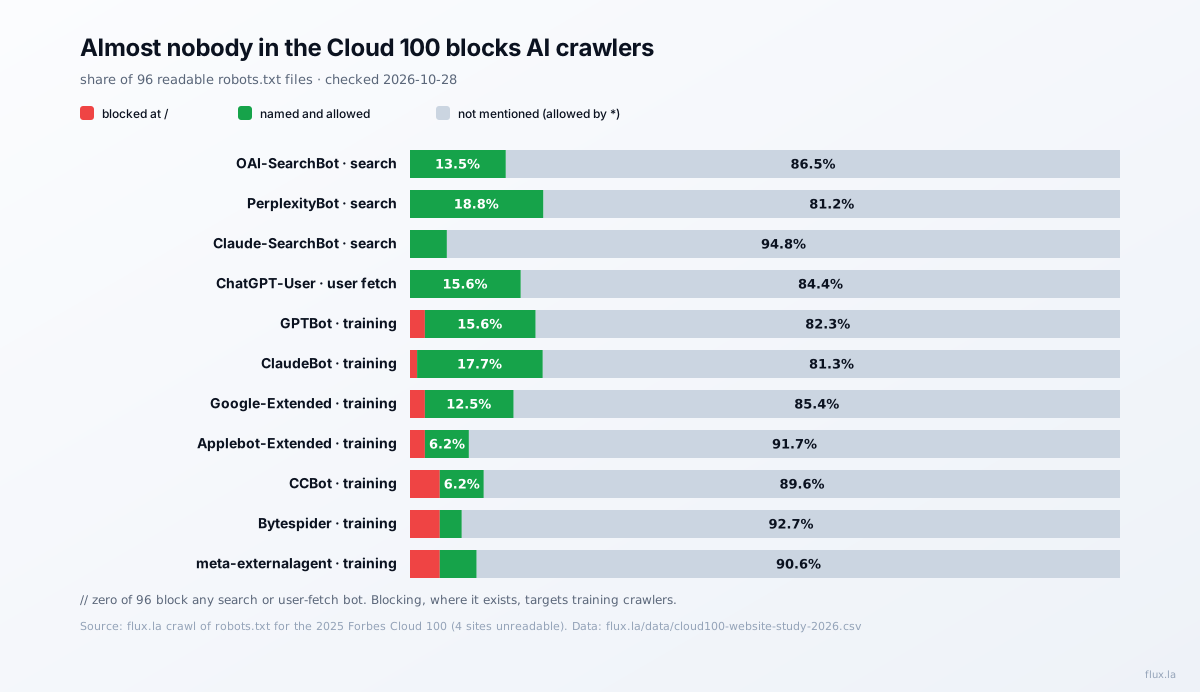
Before anything else, make sure the search and answer bots can reach you. Blocking OAI-SearchBot removes you from ChatGPT search, by OpenAI’s own documentation, and a CDN bot rule can block crawlers your robots.txt welcomes. The big software companies have mostly settled this: in our study of the Forbes Cloud 100, none of 96 readable robots.txt files blocked a search or answer bot.
Then publish an llms.txt: a plain-text index at the root of your site that tells language models which pages are canonical and what each covers. The spec lives at llmstxt.org. It is no longer a secret move: 62% of the Cloud 100 already publish one. Be clear about what it is for, though. Google says you “don’t need to create new machine readable files” to appear in AI Overviews; the payoff is with agents and assistants that fetch the file directly.
Generate it at build time from your content collection and keep it curated. A 300 KB dump of every URL is a worse sitemap, not a better llms.txt.
4. Schema.org markup on every page — not just “good to have”
Article, Person, Organization, BreadcrumbList. These describe who wrote what, about which entity, and where it sits on your site, and they are what Google’s rich results and other machine readers rely on. Two older favorites have lost their payoff: Google retired HowTo rich results and limited FAQ rich results to authoritative government and health sites in 2023, so add those types for meaning, not for a SERP feature. We looked at what the largest software companies actually ship in our homepage schema study.
The biggest mistake we see: sites that add Article schema with no wordCount, no dateModified, no articleSection, and a generic author object without sameAs links. Half-implemented schema is barely better than no schema. Either commit or skip it. (See the full 2026 SEO playbook for the schema set we run across the portfolio.)
Test every release at validator.schema.org and search.google.com/test/rich-results.
5. Original data > original opinion
If your post contains a number, percentage, or dated finding that doesn’t appear anywhere else on the web, it gives an answer engine something only you can be cited for. A sentence like “Only 23 of the Forbes Cloud 100 pass Core Web Vitals on mobile” (from our CrUX study) is specific, dated and attributable, which is what gets quoted.
You don’t need a massive study. Public data sources (CrUX, robots.txt files, your own Search Console) are enough for a small, honest analysis. Our Search Console prompt-query analysis used nothing but our own property. Publish the method alongside the number so others can trust it.
6. Reading time, word count, and update dates — visible
LLMs and Google both prefer recent, substantive content. Show the publish date, the modified date, the word count, and the estimated reading time on every post. Don’t hide them in metadata only. Render them on the page where humans (and LLMs) can see them.
Bonus: bump the modified date when you do a real content refresh, not just a typo fix. We bump on substantive rewrites, year refreshes, or new H2 sections — never on minor edits.
7. The blockquote pull-out as LLM bait
Wrap one quotable, citable claim per post in a <blockquote>. LLMs heavily favor blockquoted content as “the key takeaway.” Make sure that takeaway is a specific claim with a number, name, or dated reference — not a generic platitude.
Bad blockquote: “Content is king.” Good blockquote: “In Pew Research’s 2025 panel, people clicked a traditional result on 8% of Google visits with an AI summary, against 15% without one.” (Source and context.)
8. Single H1, 3+ H2 sections, 1+ H3 per H2
The structural minimum for any post that wants to rank. Most listicles get this wrong — they use H2 for every list item, leaving no real hierarchy. Use H2 for actual section breaks (3-7 per post) and H3 for sub-points within each.
Posts under 600 words don’t compound. They’re notes. Don’t pretend they’re posts.
9. Canonical URLs, trailing slashes, and no date in the URL
/posts/hidden-seo-tricks/ is the right URL pattern. Not /2022/05/hidden-seo-tricks (dates date the post). Not /posts/hidden-seo-tricks (Cloudflare and many CDNs treat trailing-slash variants as different URLs). Pick a convention and enforce it in _redirects.
Every page has a canonical URL set in the <head>. Never let two URLs compete for the same content — canonical errors are one of the first things a technical SEO audit should catch.
10. The “answer-shaped” H2
LLMs cite content that matches the structure of the question. If the query is “how to do SEO in 2026,” the post that says <h2>How SEO works in 2026</h2> is more likely to be cited than the post that says <h2>The Modern SEO Landscape</h2>. Write H2s as the literal question or claim, not as a clever editorial label.
Look at your last 10 posts. Count how many H2s are actual questions or specific claims vs. abstract labels. The ratio tells you how citable the post is. (For the eight content campaigns we studied that nailed this in 2024-2026, see content marketing campaigns that actually worked.)
What we don’t do anymore
Three tactics we explicitly avoid in 2026:
- Generic listicle content with no original data. AI Overviews quote them once and burn them.
- Keyword stuffing. Helpful Content Update destroyed sites that did this. Don’t.
- Spammy backlink schemes. Google’s spam policies name paid links, link exchanges and keyword-anchored links in distributed press releases. Earn links by publishing things worth linking to.
How we measure
Once a quarter we run 10 flagship queries from each client’s niche through ChatGPT, Perplexity, Gemini, Claude, and Google AI Overviews. We log which (if any) of their URLs get cited. Goal for a 90-day GEO engagement: at least 30% of niche flagship queries cite at least one client URL.
That’s the only real GEO metric. Everything else (impressions, click-through rate, “AI visibility score”) is a proxy.
If you want help applying these — or you want us to run the 90-day GEO sprint on your site — tell us what you’re working on.
One copyable AI agent, every Wednesday.
Flux founder Alejandro Rioja's weekly newsletter for operators: an agent he shipped that week, one growth experiment with real numbers, and what's working across SEO and GEO right now.
Free · 1-click unsubscribe · confirm by email and you're in.
Alejandro Rioja
Operator who builds and sells marketing-focused brands. Founder of Pickleland, founder of Flux.LA, writing about AI SEO + GEO at alejandrorioja.com.